 Skip-the-line available
 What to See Inside the Doge's Palace
The Golden Staircase, the great chambers, Tintoretto's Paradise and the Bridge of Sighs — a concierge highlights guide.
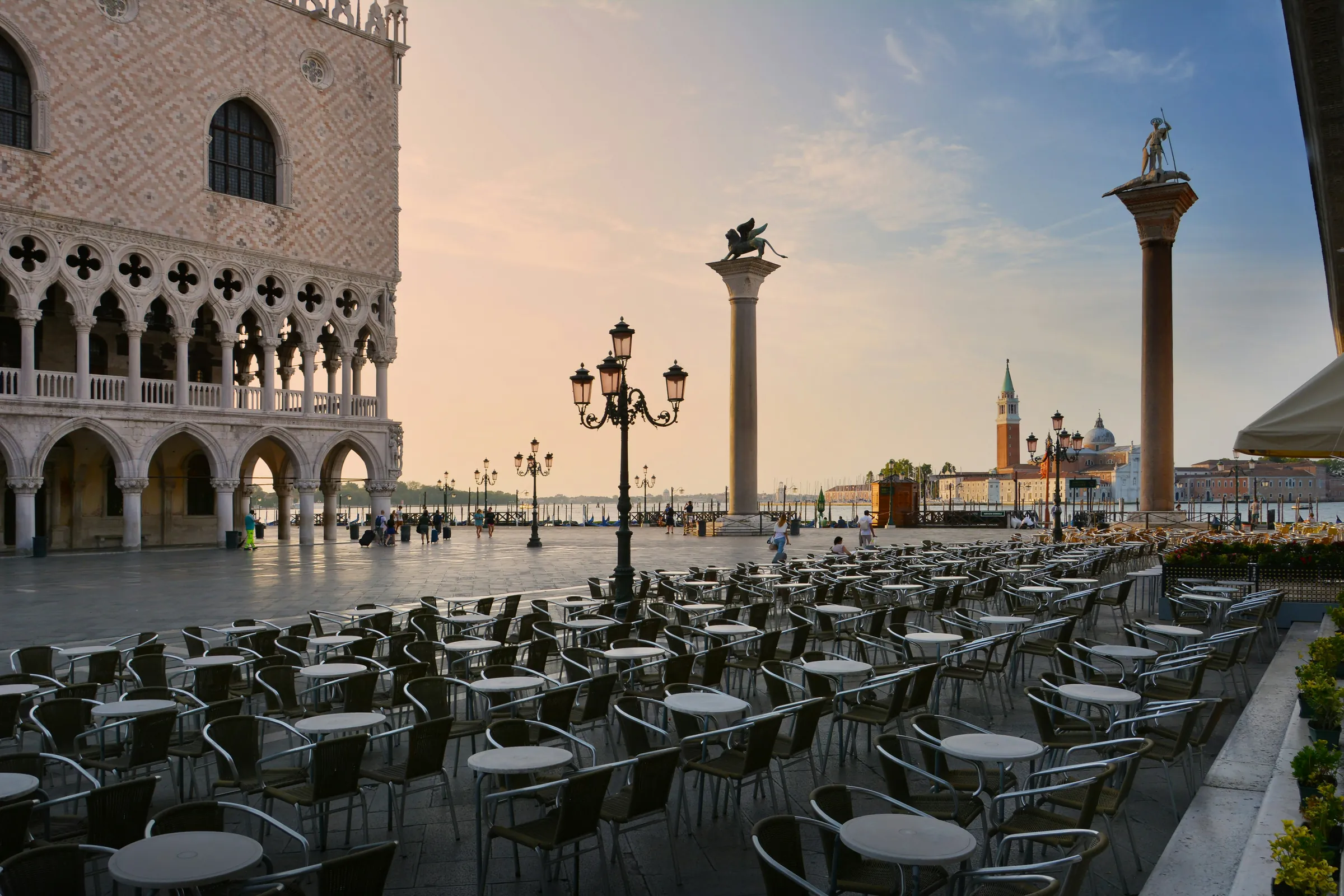
The Doge's Palace was the seat of the Venetian Republic for centuries — the residence of the Doge, the meeting place of its great councils, the courts, and the state prisons all in one Venetian Gothic building on St Mark's Square. A visit follows a set route: through the internal courtyard past the Scala dei Giganti (Giants' Staircase), up the gilded Scala d'Oro (Golden Staircase) to the institutional chambers, into the vast Great Council Chamber with Tintoretto's Paradise, through the armoury, and finally across the Bridge of Sighs into the New Prisons. This guide covers the courtyard and staircases, the government chambers, the great paintings, the armoury, and the prisons — the highlights worth pausing over on the roughly two-hour walk.
What are the courtyard and the two great staircases?
The visit begins in the internal courtyard of the Doge's Palace, an open square framed by Gothic and Renaissance facades that reveals how three functions — palace, government seat and law court — were folded into one building. Dominating it is the Scala dei Giganti, the Giants' Staircase, completed around 1485 and named for the two colossal statues of Mars and Neptune carved by Jacopo Sansovino in the 1560s, symbols of Venice's power on land and sea. Newly elected doges were crowned at the top of this staircase. The courtyard also holds two ornate bronze well-heads and gives the clearest view of the palace's layered architectural history, from the fourteenth-century Gothic wings to the Renaissance rebuilding that followed a series of fires. Pause here before climbing, because the courtyard is the one point where you can take in the full sweep of the building from the inside.
From the courtyard the route climbs the Scala d'Oro, the Golden Staircase, the ceremonial approach to the government floors designed by Jacopo Sansovino and completed in 1559. Its barrel vault is encrusted with white-and-gold stucco and gilded reliefs, and it was the route by which important visitors were led up to the seat of Venetian power — a deliberate display of the Republic's wealth. The staircase takes its name from the lavish gold-leaf decoration overhead. At the top it opens into the sequence of institutional rooms where the Republic was governed. Climbing the Scala d'Oro is one of the signature moments of the visit, so it is worth pausing to look up at the ornamented ceiling before moving into the chambers. Early in the day you can do this without the press of a crowd behind you, which is why an early entry rewards this part of the route especially well.
Which government chambers should I see?
The upper floors of the Doge's Palace hold the chambers where the Venetian Republic actually governed, and they are the heart of the visit. The route passes through the Doge's Apartments, the Sala delle Quattro Porte, the Anticollegio, the Collegio and the Senate Chamber, each richly decorated with painted ceilings and history paintings glorifying Venice. Most striking are the rooms of the Council of Ten, the feared security committee, and the adjoining Sala della Bussola with its bocca di leone — a stone lion's-mouth letter-box into which citizens once posted secret denunciations. These rooms show how a small elected republic ran an empire through layered councils and committees rather than a single ruler. Their ceilings and walls carry works by Veronese, Tintoretto and Palma il Giovane. Move through them in sequence, as the route is designed to trace the Republic's chain of decision-making from committee to full council chamber.
The climax of the government floor is the Sala del Maggior Consiglio, the Great Council Chamber, one of the largest rooms in Europe of its time at roughly 53 metres long and 25 metres wide. Here the Republic's noble assembly — sometimes well over a thousand members — met to elect officials and pass laws, seated beneath a ceiling of gilded history paintings. A frieze of portraits of the doges runs around the upper walls, with one space famously painted black to mark Marino Faliero, the doge executed for treason in 1355. The sheer scale of the chamber conveys the breadth of Venice's governing class better than any single artwork. Stand at the entrance end and look the full length of the room toward the doge's tribunal to grasp how the Republic staged its own authority. It is the room most visitors remember long afterwards.
What are the great paintings inside the Doge's Palace?
The single most celebrated painting in the Doge's Palace is Tintoretto's Il Paradiso (Paradise), which fills the wall behind the doge's tribunal in the Great Council Chamber. Painted in the 1580s by Jacopo Tintoretto with his workshop and son Domenico, it is among the largest old-master canvas paintings in the world, roughly 22 metres wide, and depicts hundreds of figures massed in the heavens. It replaced an earlier fresco lost in the fire of 1577. Above it, the ceiling centres on Veronese's Apotheosis of Venice, showing the city crowned as a triumphant queen. Together they turn the chamber into a statement of the Republic's self-image as blessed and eternal. Because the Paradiso is so vast and detailed, it repays a slow look from the far end of the room, where the full composition resolves. It is the artistic high point of the entire palace visit.
Beyond the Great Council Chamber, the Doge's Palace holds one of the richest collections of Venetian state painting anywhere, much of it created to replace works lost in the fires of 1574 and 1577. Paolo Veronese's ceiling canvases in the Collegio and the Sala del Consiglio dei Dieci, and Tintoretto's mythological and allegorical panels throughout the government rooms, celebrate Venice's virtues, victories and divine favour. The Anticollegio holds several prized mythological scenes, including works by Veronese and Tintoretto, in what was the antechamber where ambassadors waited for an audience. These are not decorative afterthoughts but propaganda in paint, commissioned to impress foreign envoys with the Republic's grandeur. Look up frequently as you move through the rooms, because much of the finest work is set into the gilded ceilings rather than hung at eye level. The painted ceilings are among the palace's greatest treasures overall.
What is the armoury, and what is the Bridge of Sighs?
The armoury (Sala d'Armi) of the Doge's Palace occupies several rooms and displays the Republic's historic arsenal — suits of armour, swords, crossbows, halberds, early firearms and ceremonial weapons collected over centuries by the Council of Ten. Highlights include parade armour, a full horse-and-rider set, and captured trophies such as pieces linked to the aftermath of the naval Battle of Lepanto in 1571. The collection is a reminder that the palace was not only a court and residence but the command centre of a maritime power that controlled trade routes across the Mediterranean. The rooms are arranged roughly by type of weapon, and they make a striking contrast with the gilded council chambers you have just left. Allow a little time here, as the armoury is often quieter than the great chambers and rewards a close look at the craftsmanship of the arms and armour on display throughout.
The Bridge of Sighs (Ponte dei Sospiri) is the enclosed limestone bridge, built around 1600, that arches over the Rio di Palazzo canal to link the Doge's Palace with the New Prisons on the far bank. Its romantic name is a nineteenth-century invention — the poet Lord Byron popularised the idea that prisoners sighed at their last view of Venice through its stone-latticed windows before being led down to the cells. Inside, the bridge is divided into two narrow passages, and visitors cross it on the route from the palace's judicial rooms to the prisons, glimpsing the lagoon through the small barred openings. It is one of the most photographed structures in Venice, best seen from outside on the Ponte della Paglia bridge. Crossing it from within is a highlight of the palace visit and a direct link between the Republic's courts and its jails.
Can I visit the prisons where Casanova was held?
Yes — the route through the Doge's Palace crosses the Bridge of Sighs into the New Prisons (Prigioni Nuove), a seventeenth-century block on the far side of the canal whose bare stone cells you can walk through. The palace also contained two older sets of cells within its own walls: the Pozzi, the damp wells on the ground floor, and the Piombi, the leads, named for the lead roof directly above these upper cells that made them stifling in summer and freezing in winter. The Piombi are famous as the prison from which Giacomo Casanova staged his celebrated escape in 1756, breaking through the ceiling and out across the palace roof. The patriot and writer Silvio Pellico was also held here in the nineteenth century. Walking the cells and the connecting passages gives a vivid sense of the Republic's justice, and it is the part children find most memorable.
The prisons are reached near the end of the standard visitor route, after the government chambers and the armoury, so they make a natural close to the tour before you exit back onto St Mark's Square. Beyond the general route, the Doge's Palace also offers a separate guided Secret Itineraries tour of the hidden administrative rooms, the interrogation chambers of the Council of Ten and the cramped Piombi cells where Casanova was held — spaces not on the ordinary path. This tour must be booked separately and runs at set times in several languages. For a first visit the standard route through the New Prisons and across the Bridge of Sighs captures the essential experience; the Secret Itineraries add depth for returning visitors or anyone drawn to the darker workings of the Republic. Either way, the prisons are the atmospheric finale of the palace.
Frequently asked
What are the must-see highlights inside the Doge's Palace?
The Scala d'Oro (Golden Staircase), the Great Council Chamber with Tintoretto's Paradise, the armoury, and the Bridge of Sighs leading to the prisons. The internal courtyard with the Giants' Staircase, where doges were crowned, is the best introductory view.
What is Tintoretto's Paradise in the Doge's Palace?
Il Paradiso is a vast canvas, roughly 22 metres wide, filling the wall behind the doge's tribunal in the Great Council Chamber. Painted by Tintoretto and his workshop in the 1580s, it is among the largest old-master paintings in the world and depicts hundreds of figures in the heavens.
What is the Great Council Chamber?
The Sala del Maggior Consiglio is one of the largest rooms of its era in Europe, about 53 metres long. The Republic's noble assembly met here to elect officials and pass laws. A frieze of doge portraits circles the walls, with one blacked out for the executed Marino Faliero.
Can I cross the Bridge of Sighs inside the Doge's Palace?
Yes. The enclosed limestone bridge, built around 1600, links the palace's judicial rooms to the New Prisons across the canal, and the visitor route crosses it. Its two narrow passages give a glimpse of the lagoon through stone-latticed windows before reaching the cells.
Where was Casanova imprisoned in the Doge's Palace?
Giacomo Casanova was held in the Piombi, the leads, the upper cells beneath the palace's lead roof, and famously escaped in 1756 by breaking through the ceiling. These cells feature on the separate Secret Itineraries guided tour rather than the standard route.
What is the Scala d'Oro?
The Scala d'Oro, or Golden Staircase, is the ceremonial stair to the government floors, designed by Jacopo Sansovino and completed in 1559. Its barrel vault is covered in white-and-gold stucco and gilded reliefs, and it was the route by which important visitors were led to Venetian power.
What is in the Doge's Palace armoury?
The Sala d'Armi displays the Republic's historic arsenal — armour, swords, crossbows, halberds, early firearms and ceremonial weapons gathered by the Council of Ten, including trophies linked to the 1571 Battle of Lepanto. It is often quieter than the great chambers.
How long is the route through the Doge's Palace?
Allow about two hours to follow the full route: the courtyard and Giants' Staircase, the Golden Staircase, the government chambers, the Great Council Chamber, the armoury, the Bridge of Sighs and the New Prisons before exiting back to St Mark's Square.
What are the Secret Itineraries at the Doge's Palace?
A separate guided tour of hidden rooms not on the standard route — the administrative offices, the Council of Ten's interrogation chamber, and the Piombi cells where Casanova was held. It must be booked separately and runs at set times in several languages.