 Skip-the-line available
 The History of the Doge's Palace
From a ninth-century fortress to the Gothic seat of the Doge — a concierge history of Venice's most powerful building.
The Doge's Palace (Palazzo Ducale) in Venice was for a thousand years the seat of the Venetian Republic — the residence of the Doge, the meeting place of its councils, the supreme law court, and the state prison, all in one building on St Mark's Square. First established around 810 under Doge Agnello Participazio, it was rebuilt in its present Venetian Gothic form from about 1340, with the ceremonial Porta della Carta gateway completed in 1442. Fires, reconstructions and the great painters of Venice shaped its interior over the centuries, until the Republic fell to Napoleon in 1797. It became a public museum in 1923. This guide traces the building's founding, its Gothic rebuilding, the fires and Renaissance restorations, and its role as the engine of the Republic.
When was the Doge's Palace founded?
The Doge's Palace traces its origins to around 810, when Doge Agnello Participazio established a fortified seat of government on the site beside what became St Mark's Square in Venice. That first structure was a moated castle rather than the airy Gothic palace seen today, and it was rebuilt and enlarged repeatedly over the following centuries as the Venetian Republic grew from a lagoon settlement into a Mediterranean trading power. The building's dual purpose was fixed early: it was both the residence of the Doge, the Republic's elected head of state, and the meeting place of its governing councils. Its position on the Piazzetta, between St Mark's Basilica and the lagoon, placed the seat of secular power beside the seat of religious power at the ceremonial heart of Venice. Almost nothing of the ninth-century fortress survives; the palace visitors see today is essentially a Gothic and Renaissance creation.
Over the ninth to thirteenth centuries the Doge's Palace was damaged by fire and rebuilt several times as Venice's institutions matured and its wealth grew from maritime trade. By the early fourteenth century the earlier fortified building no longer suited a confident republic that governed by large councils rather than a single strongman, and a decision was taken to replace it with a grand new palace fit to house the expanding Great Council. The Doge himself was an elected official hemmed in by councils and oaths, not a monarch, so the building was designed to glorify the Republic and its collective government rather than any one ruler. This political character — power shared among an aristocratic elite — shaped everything about the palace that followed, from the vast council chamber to the surveillance rooms of the Council of Ten. The Gothic rebuilding that began around 1340 gave Venice the palace it kept until the Republic's end.
How was the Gothic palace built?
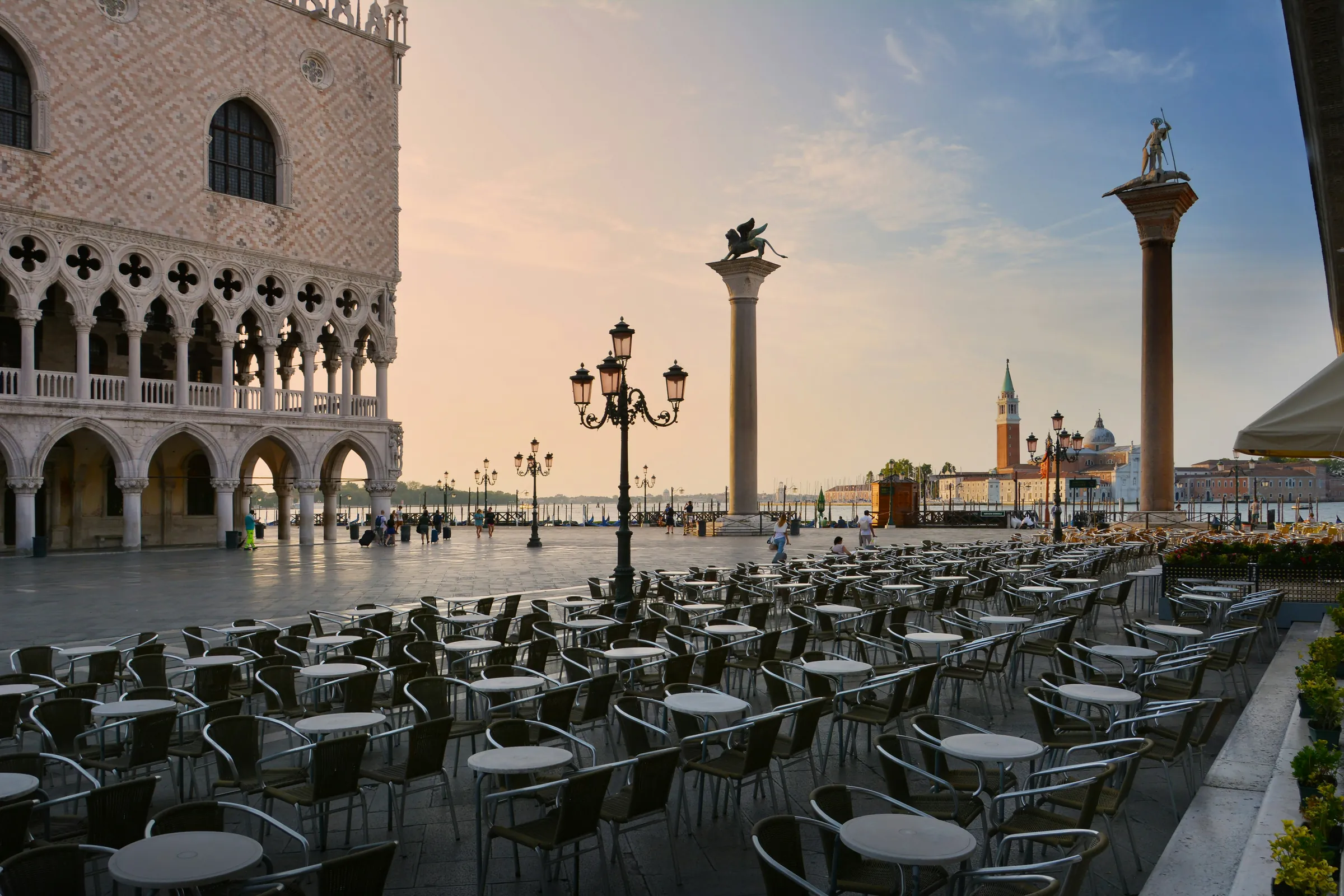
The Doge's Palace as it stands today was built largely in the Venetian Gothic style from about 1340 onwards, when work began on the great wing facing the lagoon to house the enlarged Great Council. The distinctive design — a heavy upper wall of pink Verona marble resting on two tiers of delicate white Istrian-stone arcades, seeming to float above open loggias — inverts the usual logic of a fortress and became one of the defining images of Venice. The fourteenth-century sculptor Filippo Calendario is associated with the early Gothic work. The wing facing the Piazzetta was extended in the same style in the following century, and the ceremonial land gate, the Porta della Carta, was completed by Giovanni and Bartolomeo Bon in 1442. The result was a palace that expressed confidence rather than defence, its lace-like lower arcades a statement that Venice, protected by its lagoon, feared no attacker.
The Renaissance left its mark on the Doge's Palace in the courtyard and the interior. After a fire in 1483 damaged the Doge's Apartments, the architect Antonio Rizzo led a rebuilding in the new Renaissance manner, and the Scala dei Giganti (Giants' Staircase) was completed around 1485, later crowned with Sansovino's colossal statues of Mars and Neptune in the 1560s. The gilded Scala d'Oro (Golden Staircase), designed by Jacopo Sansovino, was finished in 1559. Meanwhile Antonio da Ponte — the engineer who would later build the stone Rialto Bridge — was among those involved in reconstruction after later fires. So while the palace's exterior stayed faithful to its fourteenth-century Gothic design even through repeated rebuilding, its courtyard and staircases blend Gothic and Renaissance work, tracing two centuries of Venetian architecture in a single building. This deliberate continuity of the Gothic facade is itself a remarkable choice.
What fires shaped the palace, and who rebuilt it?
A series of fires repeatedly gutted the interior of the Doge's Palace and forced its greatest reconstructions. A blaze in 1483 destroyed much of the Doge's Apartments, prompting Antonio Rizzo's Renaissance rebuilding of the east wing and courtyard. Far more destructive were the fires of 1574, which damaged the second-floor rooms, and 1577, which gutted the Scrutinio Room and the Great Council Chamber and destroyed a wealth of earlier frescoes, including works by Gentile da Fabriano, Pisanello and Titian. The Republic chose to rebuild faithfully within the existing Gothic shell rather than replace the palace, and after debate rejected a radical redesign proposed by Andrea Palladio in favour of restoring the original form. The reconstruction was overseen by Antonio da Ponte and others. It is thanks to this decision to preserve the Gothic exterior that the palace still presents its fourteenth-century face to St Mark's Square today.
The rebuilding after the 1577 fire is why so much of the art inside the Doge's Palace dates from the late sixteenth century rather than earlier. With the old frescoes lost, the Republic commissioned a new cycle of canvases from the leading painters of the day — Tintoretto, Veronese and Palma il Giovane among them — to glorify Venice, its virtues and its history across the ceilings and walls of the restored chambers. Tintoretto's vast Il Paradiso, installed in the Great Council Chamber in the 1580s to replace a burnt fresco, dates from exactly this campaign. So the palace's decorative scheme is in large part a monument to recovery: an act of civic will to rebuild grander than before after catastrophe. The consistency of theme across these late-sixteenth-century works — Venice blessed, victorious and eternal — reflects a coordinated programme of state propaganda in paint.
What role did the palace play in the Venetian Republic?
The Doge's Palace was the working seat of government for the Venetian Republic, a state that endured for over a thousand years until 1797. Under one roof it held the Doge's residence, the debating chambers of the Great Council and the Senate, the executive Collegio, the powerful Council of Ten that oversaw state security, the law courts, and the prisons. The Doge, elected for life by an elaborate multi-stage ballot, was the ceremonial head of state but bound tightly by councils and by his promissione, an oath limiting his powers, so real authority lay with the aristocratic councils that met in these rooms. The palace was therefore the physical embodiment of Venice's unusual system of collective, checked government. Its layout, folding residence, legislature, courts and jail into one building, let the entire machinery of the Republic operate within a few dozen metres on St Mark's Square.
The Republic's end came in 1797, when Napoleon Bonaparte's advance forced the last Doge, Ludovico Manin, and the Great Council to vote themselves out of existence, ending more than a millennium of Venetian independence. Under the subsequent French and then Austrian rule the palace lost its governing function and served various administrative uses through the nineteenth century. In 1923 the Italian state opened the Doge's Palace to the public as a museum, and it has been managed since as one of the civic museums of Venice grouped around St Mark's Square. Today the same standard ticket that admits visitors to the palace also covers the neighbouring Museo Correr, the National Archaeological Museum and the monumental rooms of the Marciana Library. What was for a thousand years the closed heart of a secretive republic is now among the most visited historic buildings in Italy.
Why is the Doge's Palace a UNESCO World Heritage site?
The Doge's Palace is part of the UNESCO World Heritage site Venice and its Lagoon, inscribed in 1987, which recognises the entire city and its surrounding lagoon as an outstanding example of a built environment shaped by human ingenuity and the water. Venice is celebrated as a unique achievement — a great city and maritime empire raised on more than a hundred small islands, its architecture and art an unbroken record from the Byzantine period through the Gothic and Renaissance to the eighteenth century. The Doge's Palace, standing at the ceremonial centre on St Mark's Square, is among the site's defining monuments, embodying the political and artistic peak of the Venetian Republic. Its Venetian Gothic facade and its cycle of state paintings by Tintoretto and Veronese are counted among the reasons the wider ensemble carries outstanding universal value. The palace is thus protected not in isolation but as part of an entire recognised city.
The World Heritage listing underlines how completely Venice merged art, government and the natural setting of the lagoon, and the Doge's Palace concentrates that story in a single building. It was here that a small merchant republic developed sophisticated institutions of law, diplomacy and finance, and celebrated them in paint and marble on a scale meant to overawe visiting ambassadors. The palace's survival — through fires, the fall of the Republic in 1797, and the constant threat of flooding from the lagoon it faces — makes it a living document of Venetian history. For visitors today, walking the courtyard, the council chambers and the prisons is a direct encounter with the machinery of a state that shaped Mediterranean trade and European art for centuries. That is why the Doge's Palace remains the essential stop on any first visit to St Mark's Square.
Frequently asked
When was the Doge's Palace founded?
The first fortified seat of government on the site dates to around 810, under Doge Agnello Participazio. Almost nothing of that ninth-century fortress survives; the palace seen today was rebuilt in Venetian Gothic style from about 1340 onwards.
What architectural style is the Doge's Palace?
Venetian Gothic. Its distinctive facade sets a heavy upper wall of pink Verona marble above two tiers of delicate white Istrian-stone arcades, so the solid mass appears to float above open loggias — one of the defining images of Venice.
What was the Doge's Palace used for?
It was the seat of the Venetian Republic: the Doge's residence, the meeting place of the Great Council and Senate, the executive Collegio, the Council of Ten, the law courts and the state prisons — the entire machinery of government under one roof on St Mark's Square.
Who was the Doge?
The Doge was the elected head of state of the Venetian Republic, chosen for life by an elaborate multi-stage ballot but bound tightly by councils and by an oath limiting his powers. Real authority rested with the aristocratic councils that met in the palace.
What fires damaged the Doge's Palace?
Major fires struck in 1483, 1574 and 1577. The 1577 fire gutted the Great Council Chamber and destroyed frescoes by Titian, Pisanello and Gentile da Fabriano. The Republic rebuilt faithfully within the Gothic shell and commissioned new paintings from Tintoretto and Veronese.
When did the Venetian Republic end?
In 1797, when Napoleon's advance forced the last Doge, Ludovico Manin, and the Great Council to vote the Republic out of existence, ending over a thousand years of Venetian independence. The palace then passed to French and Austrian administrative use.
When did the Doge's Palace become a museum?
The Italian state opened the Doge's Palace to the public as a museum in 1923. It is now one of the civic museums of Venice grouped around St Mark's Square, sharing a standard ticket with the Museo Correr and other museums on the square.
Is the Doge's Palace a UNESCO World Heritage site?
Yes. It is part of Venice and its Lagoon, inscribed by UNESCO in 1987, which protects the whole city and lagoon. The palace is one of the ensemble's defining monuments, embodying the political and artistic peak of the Venetian Republic.
Who designed the Doge's Palace?
It is the work of many hands over centuries: the Gothic wings are linked to sculptor Filippo Calendario, the Porta della Carta to Giovanni and Bartolomeo Bon (1442), the courtyard rebuilding to Antonio Rizzo, and the Golden Staircase to Jacopo Sansovino (1559).